

 Bom dia do Rio de Janeiro.
My flight from Houston was fine, I was seated in the aisle next to a whole bunch of other Canadians. I’m pretty sure a quarter of the flight were from Alberta (Calgary, Didsbury and Edmonton) and
 Flamengo and Botafogo, letting me know that the beaches are not safe to swim in as they are very dirty from the boats. As I can pass reasonably (in looks) as a Brazilian (or at least South American), I had no issues when I went walking around the neighbourhood. It is only confusing to people when they spout off something in Portuguese and I give them a deer in the headlights look. For everyday things, such as at the grocery store, it is not so bad. I can order my food with only a slightly awful accent, and I can guess what is being said to me based off the situation (for example, at the cash register, I understood the question of whether I would be paying by cash or card).
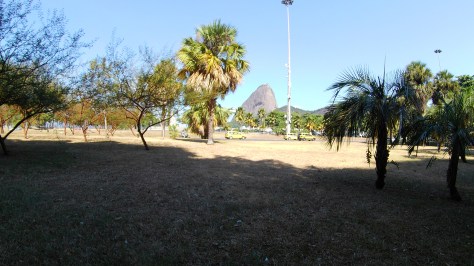
The following day (Friday/sexta-fera, or abreviated as sex) I joined my tour group in Copacabana at the Cabanacopa hostel. Given that there were almost 60 of us on tour, and several others staying at the hostel on their own or on another tour, it was quite crowded, and really could have used some extra common space, or at the very least some hammocks! I met April, who it turns out is also from Calgary, and we wandered the streets of Copacabana in search of the hotel where I needed to pick up my costume (fantasia).
Now, as there were a lot of things happening during carnival, I am going to split up the rest of this blog into categories.
The sights
It would not be a trip to Rio without going to see the most famous landmarks the city has to offer. As part of our tour, we had a city tour operated by Be a Local. Paula, our guide explained many things to us, including how the favelas are built on top of each other (if there is no room to go out, go up) and that some favelas are now safer and no longer run by gangs and drug dealers (however it’s still not a good idea to go there on your own).
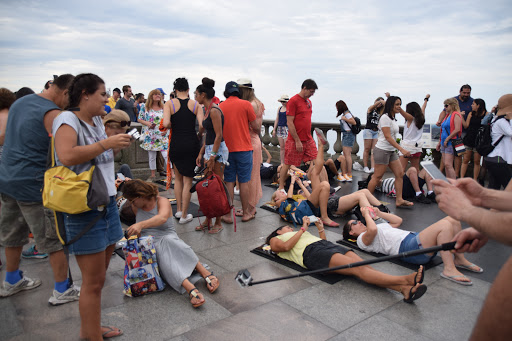 |
| Napping? Or getting the perfect picture? |
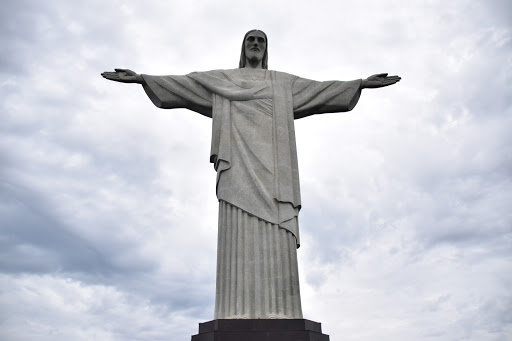
From the hostel, we headed up to the Morro do Corcovado, more famously known for Cristo Redentor, the 37 metre tall statue of Jesus Christ that overlooks Rio. It was a bit hazy today, so our views were not as spectacular as they could be. Still, you get a full view of the city below. It was quite funny to watch everyone laying on the ground, try
ing to get that perfect shot of Christ (or leaning over their phones to get a selfie of them hugging Christ). As it is high season, it was packed with tourists. I pulled the “south american timing” and was a few minutes late to meet my group as I decided to grab a juice.

Down the hill, we passed through Santa Teresa, a neighbourhood of Rio that has kept it’s colonial charm, with plenty of restaurants and nightlife. It is supposed to be quite a nice area. There is also the train that still runs up the mountain to Christ the Redeemer. Perhaps next time I go, I will try to visit longer than driving through. As we were doing our tour on the main Saturday of carnival, our tour route was adjusted to avoid the Bloco in Santa Teresa, which is one of the central areas for the street parties.
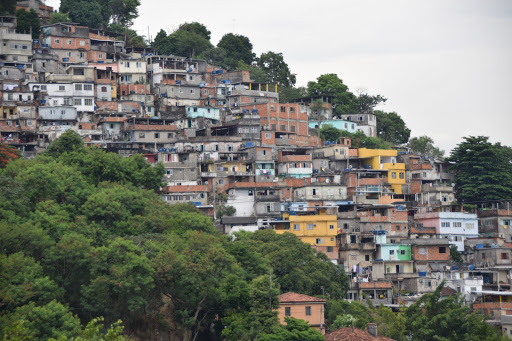 |
| Favela at Morro dos Prazeres |
Along our way down the mountain, we stopped at a lookout point to have another “scenic viewpoint”, this time looking out over the favela Morro dos Prazeres, which translated means “Mountain of Pleasures”. This favela is considered to be pacified, however, caution is always necessary, as there has been a recent murder of tourist there (who had lost their way on motorbike). This favela, along with Cidade de Deus are also known for being the location of 2 documentaries, bearing their names (Hill of Treasures, 2013 and City of God, 2002). Although the city has been working hard to reduce the amount of violence, especially in the favelas, a poor economy and increase in homelessness has led to a recent increase in more violent crimes and robberies. Some favelas, such as Rocinha and Vidigal, are considered to be safer, and you can stay there in hostels if you like, however, you need to travel smart, and keep in mind that the drug dealers are still in charge in these areas. There is increased police presence, but a lot happens “underground”. I am thinking of doing a favela tour once I get back to Rio, so that I can hopefully visit the crèche that Emily volunteered at. As for the houses, you can see just how close they are here.
Our next stop was the Escadaria Selaron, more commonly known as the Lapa Steps.
They are even more impressive in person than in pictures! However, being Carnival, it was very crowded and I didn’t get to take as many cool pictures as I would have liked.


 Curious Julie's Colourful Adventures