
So, some of you know, but I am in Morocco for spring break. I am going on a nomadic trek with a Berber family, organized through Intrepid. The trek is a semi-annual migration through the valley, moving the herds from the winter pastures to the summer pastures. I am excited to be doing what I consider a once in a lifetime experience. We are only the 3rd group to do this with the nomads. Not as hard core as Mark does, but pretty awesome, nonetheless.I arrived on March 23 to Casablanca after my very early flight from Dubai via Jeddah. The flight was fine, but the bathrooms were gross. Also, everyone was extremely pushy at customs. (Not as bad as the Haiti baggage claim though). Once through, I picked up a free 4G SIM card from Orange. Both Orange and Inwi were giving free SIM cards, and for the small price of 50 MAD (5€ equivalent) I now have 5GB of data for a month!
For those interested in traveling to Morocco, once you get to the airport, withdraw or exchange money. Unlike other countries, rates are often better before you leave the secured area, and in town, money places are closed on Sundays. At the forex, you can do both, exchange and withdraw. The current exchange rate is basically 10 dirham to 1€. Once you are out, the train is extremely easy to catch, and is only 43 dirham into Casa Voyageur station. Online, everyone says that this is where you need to catch the train to Marrakech, but we found out that you can also get it from Oasis, and save yourself backtracking about 10-15 minutes. The train from Casablanca to Marrakech runs every 2 hours from 6:55am to 8:55pm. It costs 95 dirham for second class (first was unavailable when I bought my ticket) and takes approximately 3.5 hours. The key difference between 1st and 2nd class are that in 1st, you are assigned your seat and there are only 6 people per compartment instead of 8. I had decided to spend the night in Casa, at the Ibis, to get a good night’s sleep and continue on to Marrakech in the morning. This was definitely the right decision, as I felt refreshed for my trip into Marrakech.
I met my group in the evening, and we had a (late by my standards) dinner. Originally some of us had thought to Place Djeema al Fnaa, but in the end, we went for a short walk and picked up some water.
Now onto what we will be doing. I’m currently sitting on the bus to Skoura, near where we will meet our family. There are 12 of us on the tour, ranging in ages, but several of us work in education (spring break!). I am rooming with Melissa, who is Australian but working in Spain as a teaching assistant. There is another Julie on this trip who is a school psychologist near Chicago. Then there are Kirsi and Elena from Finland, who are also teachers (Kirsi in Abu Dhabi, and Elena in Finland). Then we have Ryan and Michael from Toronto, Jen and Ian from Oz, Liam,also from Oz, Lauren (male) from UK and Jay from St. Louis. Our guide is Abdulrahman from the valley over from where we will be hiking.


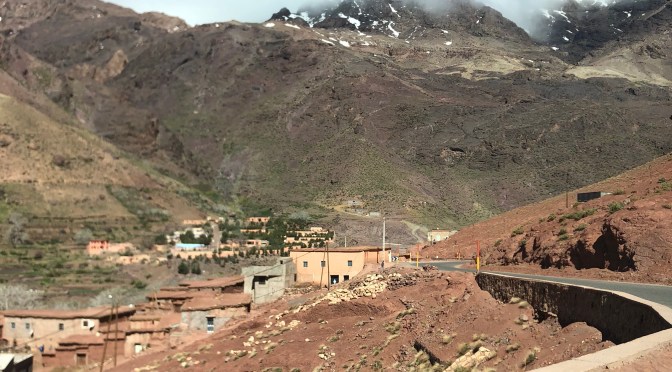
We are driving through the high Atlas Mountains which divide northern Morocco from the south. The northern slopes receive on average 800 mm of precipitation, making it lush and green, and good for agriculture. It is the area that the French were most interested in. The are a lot of Junipers, along with Evergreen Oak trees. We also saw lots of cacti with red prickly pear fruit. They use the natural protection as fences, and have recently started using the prickly pear fruit to produce an oil used in cosmetics. I also learned that date trees were not native, but brought from Mauritania when they were ruling the area.
We continued on, past the Col du Tichka, which is the highest mountain pass at 2660m. There are actually 4 mountain ranges in Morocco, and 3 climates (Mediterranean, continental and semi-arid). The name Morocco comes likely from a Portuguese mispronunciation of Marrakech, which in the Berber language translates to land of God. (Any shared land such as the winter pastures of Marrakech are considered to be the land of God.)

Onto the southern slopes, we have entered the semi-arid climate, which receives less than 400 mm of precipitation a year. Junipers and stippa grass is what dots the landscape, with poplar trees growing along the river bed. A lot of the trees have just started to bud/leaf and the valleys are the bright green of new foliage.
We also noticed a lot of stray dogs, and Abdulrahman explained that the reason Muslims do not like dogs is because they believe that the angels cannot enter when a dog is present (the prophet Mohammad didn’t receive his prophecy one evening, and discovered a dog under his bed. When the dog was gone, the angels returned to him with the prophecies). Cats, on the other hand are well liked. However, many Berbers will have dogs, as they help with the herds.
Speaking of herds, after lunch in Ouarzazate, we will have a couple hours more until we reach our camp. Ouarzazate is the Hollywood of Africa. Films like Lawrence of Arabia and some Brad Pitt movies were filmed here. The name Ouarzazate translates to “peaceful place “. Our itinerary is very flexible, as we basically are moving with the herd. Unfortunately, although most of Morocco has had a lot of rain this year, the south east of Morocco has been in a drought. The herd is smaller and weaker, so we may not cover as much distance, and we might have more free time in the afternoons (most of our walking is done in the morning). We will have to help set up and take down the camp, and we will be learning how to cook traditional food. Tomorrow, we will have the chance to walk with the women through some villages. We have mules who will carry our water, food and overnight gear, and muleteers to guide them. All in all, we should be around 30 people + ? animals.

I will update you again later!
 Curious Julie's Colourful Adventures