
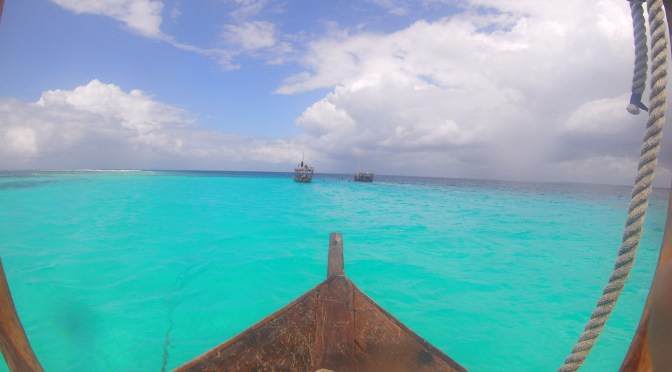

So, with summer holidays beginning, and a few extra days before I head out to Portugal, I decided to visit the tropical island haven of Zanzibar. Zanzibar is situated off the coast of Tanzania, and is a semi-autonomous part of the East African country. It has a long and complicated history, being colonized and controlled by many different countries, including Persia, Portugal, Oman, Germany (briefly), the British and finally part of the Republic of Tanzania. While under Omani rule, different spices, such as cloves, were introduced, and the island was used primarily for the slave trade. There is even a small island outside of Stone Town known as Prison Island.
Being here, with the white sand beaches and the aqua waters of the Indian Ocean, it is hard to believe that so many atrocities might have occurred in the past (particularly the slave trade). This island is truly a little piece of paradise! I am once again reminded of the fact that I am a tropical being. This is what my body craves! The lush greenery, the medium heat (25-30°C with breezes making it quite cool), the fresh fruit, the waves crashing and WHITE SAND BEACHES!! We even had quite the tropical storm today! Yes, there is a fair amount of “poverty” and most of the island lives in a very basic manner, but it is so beautiful, that it is no wonder everyone greets you with “Karibu nyumbani” which means welcome home. If someone asks you “Haberi” (how are you?), the reply is “nzuri” or “nzuri sana”. It was interesting landing here yesterday, as it is one of the first times that I was VERY aware that I was a tourist. It hit me as we flew over the houses; what must these people think of us, arriving by plane to go experience luxury while they do not… Although, I suppose, along with spices and fishing, tourism is one of the largest industries here, and the villa/hotel that I am staying at employs several people from the nearby village. The skies had opened up just as we were landing at the Zanzibar airport, however, they let up enough for us to walk from the plane to the terminal without really getting wet. As a Canadian, I was able to get my visa on arrival (50$ USD). As I was near the front of the plane, I got through customs quickly, and found my driver for Zanziblue, the hotel/villa that I am staying at in Matemwe, on the Northeastern side of the island. I have fallen out of the habit of tipping, so it took me a minute or two to realize what the guy who met me at the airport was saying… (also, as a side note, the best place to get currency is the small ATMs that are just outside of the airport (right at the entrance to the parking lot). It is also helpful to look up the conversions to Tanzanian shillings, since the amounts are very different, and what seems like a lot isn’t actually all that much…The drive itself took about an hour, and Abdi, my driver was skilled at maneuvering potholes, giant puddles, buses, children, bikes etc. The traffic in Stone Town reminded me of the chaos of Port-au-Prince, Haiti, but with worse roads (mostly because of the flooding from the recent storm). It also reminded me of getting to La Valle, in Colombia, where part of the road had been washed out due to storms. We used a “short cut” on the nice road that takes you past the Spice farms to save some time. Cloves, cinnamon, ginger, nutmeg etc. are all grown here (with cloves, nutmeg and coconut being the primary exports). After that, we drove through some rice fields before I caught my first glimpses of the Indian Ocean! The water is so blue!!
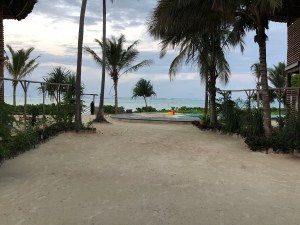 My villa is a bit out of the way, in Kilamajuu, Matemwe Town. There isn’t really a lot around, other than some other hotels and some small local houses. Once I arrived at Zanziblue, I was met by Cristina (owner) and Candy (my assistant for the time I’m here). It is weird having someone at my beck and call. Even before I arrived, Cristina was excellent, organizing food requirements, contacting the dive centre (One Ocean) for me and arranging the driver. That evening, I had dinner on my terrace looking out to the ocean. Again, it is just so beautiful and peaceful! The following day, I received more mango juice, and had a breakfast of eggs delivered to me before being picked up by One Ocean. We drove to the centre, got ourselves organized, and then took the traditional looking bus out about 30 minutes, to the boat (due to the tides, we were unable to board the boat right in town.


There are many other boats and dhows (traditional wooden boats that are used by the fishermen) there. We got a small boat out to our dhow, the Anna. From there, we sailed out to the Mnemba Atoll, where we dove. The visibility was good, and there were tons of fish! One school of snappers must have contained at least 100 fish! I saw eels, lion fish, blowfish, rock fish etc. On my second dive, we even came across a giant sea turtle nestled amongst the rocks resting! No dolphins or sharks though :(After finishing our dives, we got caught in a tropical storm, just before making it to shore. The wind and rain drove at us horizontally. We had seen the clouds building, but were hopeful that we would make it back. We were not so lucky, and absolutely EVERYTHING was soaked through. The storm itself was cool to experience, although I don’t particularly enjoy being pelted with rain. I am glad that I had not yet shed my wet suit! I was reminded that I am in the tropics, when none of my items dried, even 3 days later! This storm was the beginning of a rainy few days, where I was not able to fully enjoy my surroundings. Normally, June and July are dry…I continued to enjoy the beach, and even managed to finish my book by the ocean, (when it wasn’t raining). Otherwise, I took full advantage of the “rest and relaxation” and just hung out in my room/lounged about.


Stone Town
 On July 1st, I was driven back into Stone Town, to my next accommodation, the Zanzibar Coffee House. It was quite a difficult place to find, and my driver had to carry my bag a ways, through the Darajani Market, to find it. It is nice, although not quite what I was expecting. Because of the maze-like nature of Stone Town, and the the lack of electricity in the streets, I ended up feeling a bit “walled in”, so to speak. During the day, I went towards the Forodhani Gardens, and toured the National Palace (which has many artifacts from the last Omani sultans). It was kind of like going into an antique shop or your great-grandparents house. It was a bit musty, and everything was as it was at the end of the 19th century/beginning of the 20th century.
After that, I walked through the old Fort, and then got lost on my way back to the hotel. Just like in Marrakech, my senses were tingling, expecting the worst in this maze. Unlike Marrakech, however, the people here will help you (and try to bring you to their shops), but they do not ask for money, or give any indication that they are not simply being helpful. I made it back to the hotel just before it started raining again, and then I just stayed in my room for the night. I couldn’t be bothered to try to brave the dark, unlit streets (and I had a really good book to finish!). While I lay in bed, listening to the noisy streets outside my window, I questioned why I even bothered with Stone Town. I should have just stayed at the beach where I felt at peace!
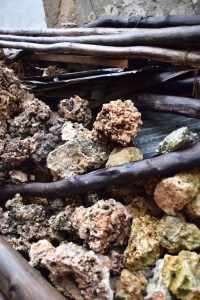
For my last day, I booked a city walking tour, so that I could get more of the history of Stone Town. I found out that the name actually comes from the fact that all the houses here are built using the coral stone and timber. I got to see a house in the process of being rebuilt, so that I could see the construction more closely. The coral is quite rough, and so it is plastered over. My guide took me through the streets to the Darajani Market, where you can find anything and everything you might need, from fish, meat, produce and spices to soap, household items, clothing etc. It is chaotic, but really, what else would you expect from the main market? We made it to the spice section before the sky opened up yet again, creating waterfalls through the tarps strung up between the stalls. As we stood waiting for the rain to lighten up, I picked a variety of spices (including pilau and tikka masala mix) to bring home. You can’t go to the Spice Island and not come back with spices, right??


By this point, my Birkenstocks were getting wet, so we crossed the rivers in the streets to go back to the hotel so I could switch to my Havaianas (which are rubber). Everyone has been telling me that the rain in June/July is not common at all, usually happening only in May. I think Mother Nature was trying to make up for all the time I have been in the desert! Of course, we are still in La niña phase, which produces more precipitation.
As we continued through the streets towards the Old Dispensary, we passed many different examples of Indian, European/Roman and Arab architecture. One thing I learned, is that the “archway” part of the door can tell you the style. If it is straight across, with wooden balconies, than it is likely done in the Indian style. Many of the doors with a semi-circular arch along the top are based on the Arabic style, and lastly, the pointed archway is from the European style. We also passed several mosques, including 3 in the same square. I learned that there are many different denominations of Muslims, and that at the time that Stone Town was being built, many of the rich families built mosques for their families and employees specifically. There are over 50 mosques in this small space, and a few Hindu temples (we visited one of them, but were not allowed to take pictures).


The Old Dispensary is built in a Victorian style (to celebrate the Golden Jubilee of Queen Victoria), and at the time that it was built (1890’s), it functioned as a dispensary (as the name suggests). Today, it is the Stone Town Cultural Centre and has a variety of shops and a restaurant or two.


The ferry terminal is across from the dispensary, and that led us to the promenade along the water’s edge. We passed the Old Customs House, which is now a nice restaurant, the Palace Museum, and the House of Wonders (which was built in 1883, and was the first building in East Africa to have electricity and an elevator!) As we kept walking, we passed through the Forodhani Gardens, which turns into a giant street food market at night. We also passed the Old Fort (where the Tourist Information Centre is). They were just setting up for the Zanzibar International Film Festival as I was leaving.


We wandered further, into the Shangani region, which is where a lot of the restaurants, tourist and tanzanite shops are. We then came across Freddy Mercury’s childhood home. I vaguely remember that Freddy was born in East Africa, but I didn’t realize it was Zanzibar! This area is neat, and if you want to sit by the beach to watch a sunset, this is the place to do it. On a random side note, the mosquitoes were not bad at all! I forgot to look beforehand, and forgot my repellent, but other than my last evening, I wasn’t bothered by them. 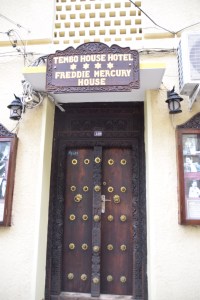
We passed St. Joseph’s Cathedral right before another downpour started. We were on our way to Jaws Corner, a local gathering point to watch sports and discuss politics, when we had to stop at a store to wait out some of the rain. This seems to be the main theme of my trip; rain! But, I’m not made of sugar, so we kept our umbrellas high and continued on towards the Hamamni Persian Baths. These are built with extremely thick plastered  walls, and different bathing areas for different temperature waters, and was the first public bath-house (for men) in Zanzibar. Nowadays, it is a historical site, without any water in it, but you can still visit to see just how large the site actually is and how deep the pools were. (It is way bigger than it looks.) The echo of the sounds inside is also quite fascinating.
I finished my walking tour on a rather heavy note, at the Old Slave Market, which is now the site of the Anglican Cathedral, and a dedicated museum to the history of the slave trade. Zanzibar played a primary role in the movement of slaves from East Africa and Madagascar to Europe and Brazil. This was also one of the longest running markets, only being shut down in 1873 by the British. During that time, men, women and children were brought in from as far away as the Congo. They had to walk most of the way, and those that survived the initial journey were then forced to stay in a basement prison. The rooms held up to 75 people, with barely enough room to sit. It only got worse for many slaves, as they were boarded onto ships like sardines, with many dying at sea.
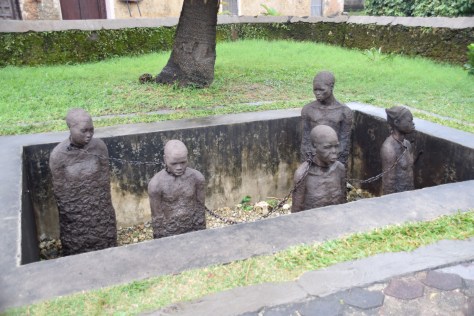
Inside the Cathedral, there are some quirks, including the fact that many of the columns near the entrance are upside down. They have also chosen to use a lot of dark wood, and red/pink tiles, seemingly to represent the blood of all the slaves that was spilled in this spot during the slave market. The history amazes me, especially as I will be traveling to Portugal and Brazil after this… I don’t understand how people can see other human beings and not give them the dignity of equality. What makes one person decide that they are better, and the others are “lesser humans”. I know this is still an issue that we face today, but I struggle to understand this mentality. Something to continue to think about…


With that, I had only a few hours left to walk around Stone Town. I grabbed a bite to eat, and then watched the sunset with a colleague and his wife (who had just landed in Zanzibar). As it was getting dark, and with the lack of electricity in the old part of town, I was thankful that they walked back to my hotel with me, so that I could collect my things and head to the airport. Onto Lisbon via DXB-CAI-ATH!
 Curious Julie's Colourful Adventures